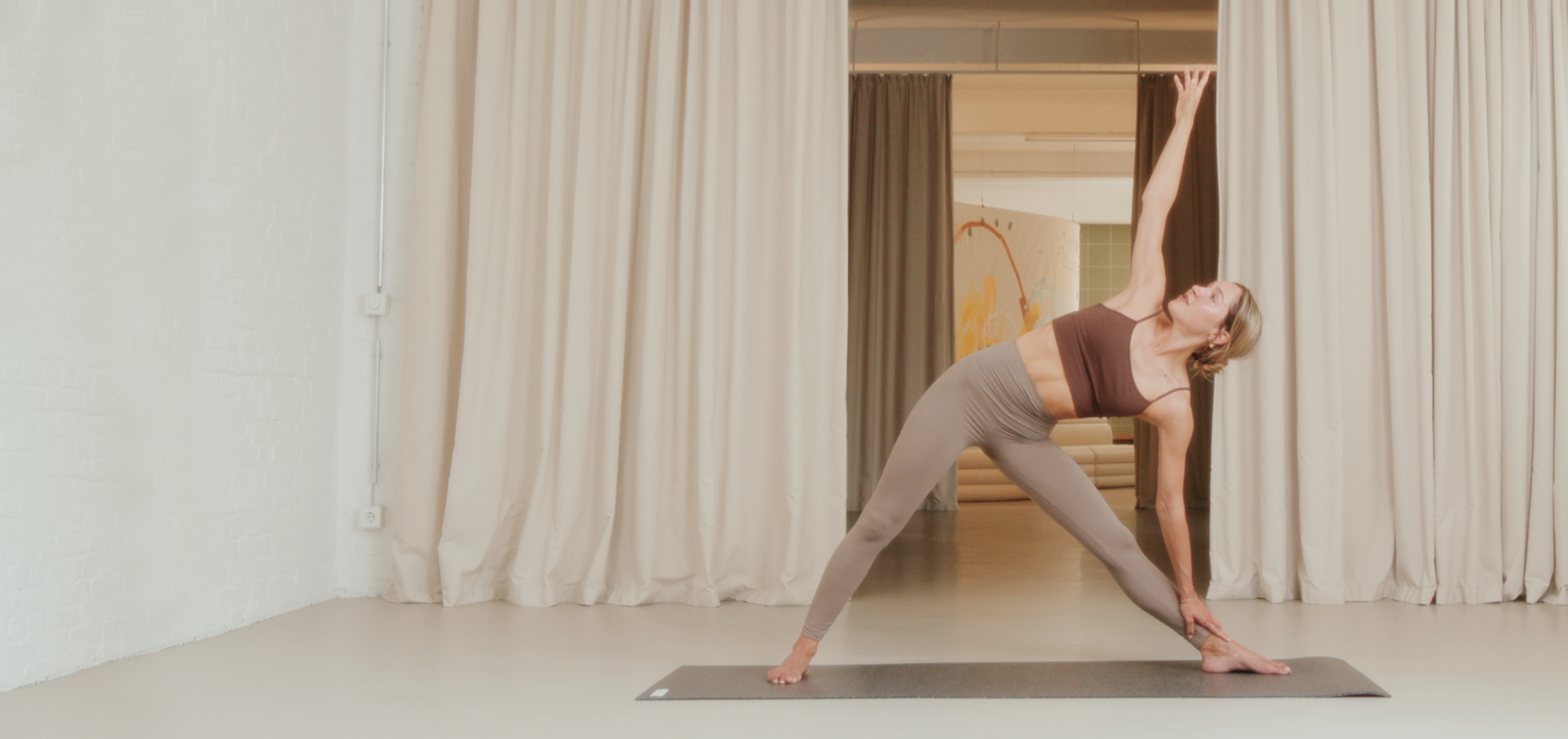

Our connection with Lena now goes beyond a shared passion for yoga and mindful movement. We've had the pleasure of filming several videos with her for our YouTube channel and got to know her as an incredibly open, reflective, and inspiring personality. We were all the more delighted to introduce her to you in more detail.
In the interview, Lena speaks honestly about her personal journey to yoga, about self-doubt, societal expectations, and how yoga helped her reconnect with herself and her body. Her perspective on body diversity in yoga and the question of how truly safe spaces can be created – spaces where people are not judged, but simply allowed to be – is particularly impressive.
The conversation powerfully demonstrates that yoga is far more than just a physical practice: it can be a place of healing, self-acceptance, and connection. Lena's words encourage us to question existing structures and to think of yoga as more inclusive, accessible, and humane.
Hey Lena, could you tell us a little about your journey? How did you come to your yoga practice and what influenced you the most along the way?
My journey to yoga began in 2018 when my dear friend Shusha simply took me to a class. I had no idea what to expect then, but I immediately felt that so-called "yoga bliss," a deep contentment and a peace I hadn't known before. A short time later, in another class, I heard about the "Kleshas," the causes of suffering, for the first time. In that moment, something changed. I understood that yoga is so much more than pure physical movement. It felt like yoga philosophy was providing answers to questions I had always carried within me.
In 2020, the same friend encouraged me to become a yoga teacher. Honestly, I had huge doubts. I thought that due to my body shape, it wasn't an option for me at all. But with the encouragement of those around me, and especially my instructor Anna, I dared to do it. Anna supported me incredibly, and I learned that every physical limitation in Asana practice is not an obstacle, but rather leads me to completely different, deeper facets of yoga.
A defining moment was in 2022 when Sophie asked if I wanted to become a teacher at Sophie Safespace. That was the first time I felt that my fat body was not a disadvantage, but perfectly fine as it was. Working as a yoga teacher today allows me a much more intensive connection to the teachings; it strengthens my own practice and has given me an understanding and depth that I would never have experienced without the training and teaching. For me, yoga today is no longer a goal I have to achieve, but a space where I can simply be.
How has your relationship with your body influenced how you practice and teach yoga?
For a long time, my relationship with my body was defined by a struggle; I often lived against it rather than with it. This was also reflected on the mat at first. The limits I encountered were, on one hand, purely physical: many poses, in the way they are usually shown, are simply not feasible for my body. This was often frustrating and always made me feel like I wasn't "right" or didn't belong.
A key moment was a yoga class where we were supposed to practice a headstand. While I sat on my mat, waiting for the others to finish, the teacher very clearly said, "Everyone in the room is now practicing the headstand." In that moment, I realized: there must be my very own version for every pose. It's not about being a perfect copy of an illustration, but about adapting the asana to my body, not my body to the asana.
That's exactly what I teach my students today. I want to empower them to believe that every body can practice yoga. It's not about perfection, but about the essence of a pose, the effect it achieves, and the feeling it evokes within us. Through yoga, I've learned to rebuild a connection with myself. Today, I practice with my body instead of fighting against it. That is the greatest gift I want to pass on in my teaching.
Have there been times when you didn't feel welcome in traditional yoga spaces? And what barriers do you still see today when it comes to access to yoga and movement for people in larger bodies?
When I look around in yoga classes today, I unfortunately still encounter a very homogeneous image. Most of the time, I am the only larger-bodied person in the room. Just that alone often triggers this subconscious feeling of not being "right" or not meeting the aesthetic expectations of that space. It can be an enormous mental barrier to enter a space where you don't see yourself represented.
However, the barriers are also quite practical: in many traditional classes, there is sometimes hardly any room for variations. I rarely feel that different body shapes are truly considered, whether through the language of the teachers or through the targeted use of props. If an exercise is instructed in such a way that my body anatomically reaches its limits – for example, because the stomach is in the way – and no alternative is offered, frustration arises. You feel left alone with your body.
My experience as a student and as a teacher at Sophie Safespace studio repeatedly shows me how great the need for true safe spaces is. The reports from my students* make it painfully clear that conventional yoga studios are simply not safe places for many people in fat bodies. A "safespace" does not arise by chance; it requires the conscious decision to not only tolerate body diversity but to actively welcome it. That's why it is so essential that there are spaces like this and other fat-friendly offerings: so that we have a place where we don't have to explain or adapt, but where our safety and well-being come first.
What does "fat friendly yoga" mean to you personally and what helped you find your own way into this practice?
To be completely honest, from my perspective, there isn't really "fat-friendly yoga" – there's only a fat-friendly approach to it. Yoga itself is a practice for every body, but the way we teach and live it determines whether someone feels welcome or not.
For me personally, this approach first and foremost means acknowledging that fat and larger-bodied people experience daily discrimination in our society. These experiences leave traces; they hurt and profoundly unsettle the connection to one's own body. A friendly approach, for me, means understanding this context and creating a space where one doesn't fight against this insecurity, but gently embraces it.
Every fat body can practice asanas, and it is our task as teachers to make this physically possible. This means actively considering different body shapes in class, offering suitable variations, and using absolutely non-judgmental language. What helped me most personally on my journey was reflecting on my own performance-oriented mindset. I had to learn to release this pressure and to encourage my students* – and myself – not only to feel their own limits but also to proudly maintain them. A safe space is created where the experience is more important than the perfect form and where one can finally stop apologizing for the space one occupies.
What do you wish for the future of the yoga community? And what inspires you the most on your personal journey?
For the future of the yoga community, I wish for one thing above all: genuine visibility and lived diversity. I hope that more and more teachers develop a deep understanding of different body shapes and integrate this knowledge not just as an add-on, but as a firm component of their teaching. Yoga should be a place where no one has to be "made to fit" first.
What inspires me most on my personal journey are the people who believed in me even before I could believe in myself. My friends and yoga colleagues Shusha and Katja, as well as my instructor Anna, conveyed to me from the very beginning that my body could practice yoga – without ifs or buts. They are three strong women who fully include fat bodies, without being "affected" by it themselves. This shows me that true solidarity and change are possible.
Furthermore, the wonderful Sophie inspires me daily, as she actively fights against the gaps in the system with her Safespace and gives so many fat FLINTA* a place where they can feel safe. But the other teachers and especially my students* also give me so much strength. Seeing that so many fat people have had similar experiences to mine has given me the most important insight of my journey: I or my body are not the problem, but rather the societal structures and prejudices that are directly transferred to the yoga scene.
And finally: What message would you like to give our readers – especially those who might think that yoga is not "for them"?
For me, yoga primarily means one thing: connection. It is the practice of learning to feel oneself again – the connection to one's own body, to breath, to the environment, and to everything that surrounds us.
Unfortunately, many of us, especially if we grow up in larger bodies, experience very early on that this very connection is denied or withheld from us. One often learns as a young girl that one is "wrong," that one should take up less space or change oneself before deserving to feel comfortable. This leads to us losing connection with ourselves and our bodies.
My message to you is: You don't have to wait until you have a certain shape or size to practice yoga. Your body is already "ready" for yoga today. I truly wish that we continue to make the spaces for this practice safer and more open, so that everyone – without fear of judgment – can experience the healing connection. You deserve to take up this space. Exactly as you are right now.